
Why is North America the only place where clothing dryers are standard?
It's not just Japan that opts to hang dry...
— Hey guys, quick plug before we start:
_First, something serious: OurOtaru Investment Guide. We spent half a year on it, it’s packed with data and everything you need if you’re considering buying in Otaru. _
Second, something silly:The YukiHomes Beanie. If you want to look as dumb as me, hit the preorder link, shipping Summer 2026, only making 50 because we are not sure how many people actually want them, so they will be limited. —

Most people reading this blog have probably been to Japan more than once. And it’s not just a Japan phenomenon, you see it all over Europe as well.
In Europe the argument usually goes something like this:
“These are old homes with limited space and no proper venting, so we stick to washers and hang dry our clothes.”
That explanation actually makes some sense. Europe has some of the oldest housing stock in the developed world. The average home in the UK is around 77 years old, and across much of Western Europe the average is well over 50 years old.
Many of these homes were built long before electric clothes dryers even existed, and retrofitting venting systems into dense apartment buildings can be difficult or impossible.
There’s also a practical infrastructure issue. Much of Europe runs on 230-volt electrical systems, which historically made high-powered electric dryers less common in residential buildings. Instead, smaller washers and air-drying became the norm. Walk through almost any European city and you’ll still see laundry lines stretching across balconies and courtyards.
So in Europe, the explanation of older buildings and dense apartments actually holds some weight.
But that argument can’t be the whole story and in Japan it’s definitely not the case.
Most homes in Japan are actually much newer than houses in the United States or Europe.
The average home in Japan is only about 33 years old, while the average home in the United States is roughly 55 years old, and homes in the UK average closer to 77 years.
Japan is famous for demolishing and rebuilding homes at a pace not really seen anywhere else in the modern world. Many houses are torn down after 30–40 years, partly due to changing earthquake standards and a culture that places a higher value on new construction.
So if Japanese houses are newer…
why don’t they have dryers?
The answer turns out to be a mix of culture, climate, and design.
First, hang-drying is simply the default in Japan. Even today, around 70% of households regularly hang their clothes to dry instead of using a machine. Walk through almost any Japanese neighborhood and you’ll see balconies covered in laundry racks and poles.
Electricity prices historically played a role as well. Dryers consume a lot of energy, and Japan has traditionally had relatively high electricity costs compared with countries like the United States.
There’s also a belief that dryers are rough on clothing. Hang drying is thought to keep fabrics looking better for longer, preventing shrinkage and extending the life of clothes.
This is a belief I hold as well and always hang any “Nice” clothes I have.
And while homes in Japan are newer, they’re also smaller. Many houses and apartments simply don’t have a dedicated laundry room where a large dryer would normally go. Instead you’ll often find a washing machine tucked into a small alcove, closet, or even on the balcony.
But here’s where Japan did some really interesting innovations.
Instead of solving the laundry problem with bigger appliances, Japan solved it with architecture.
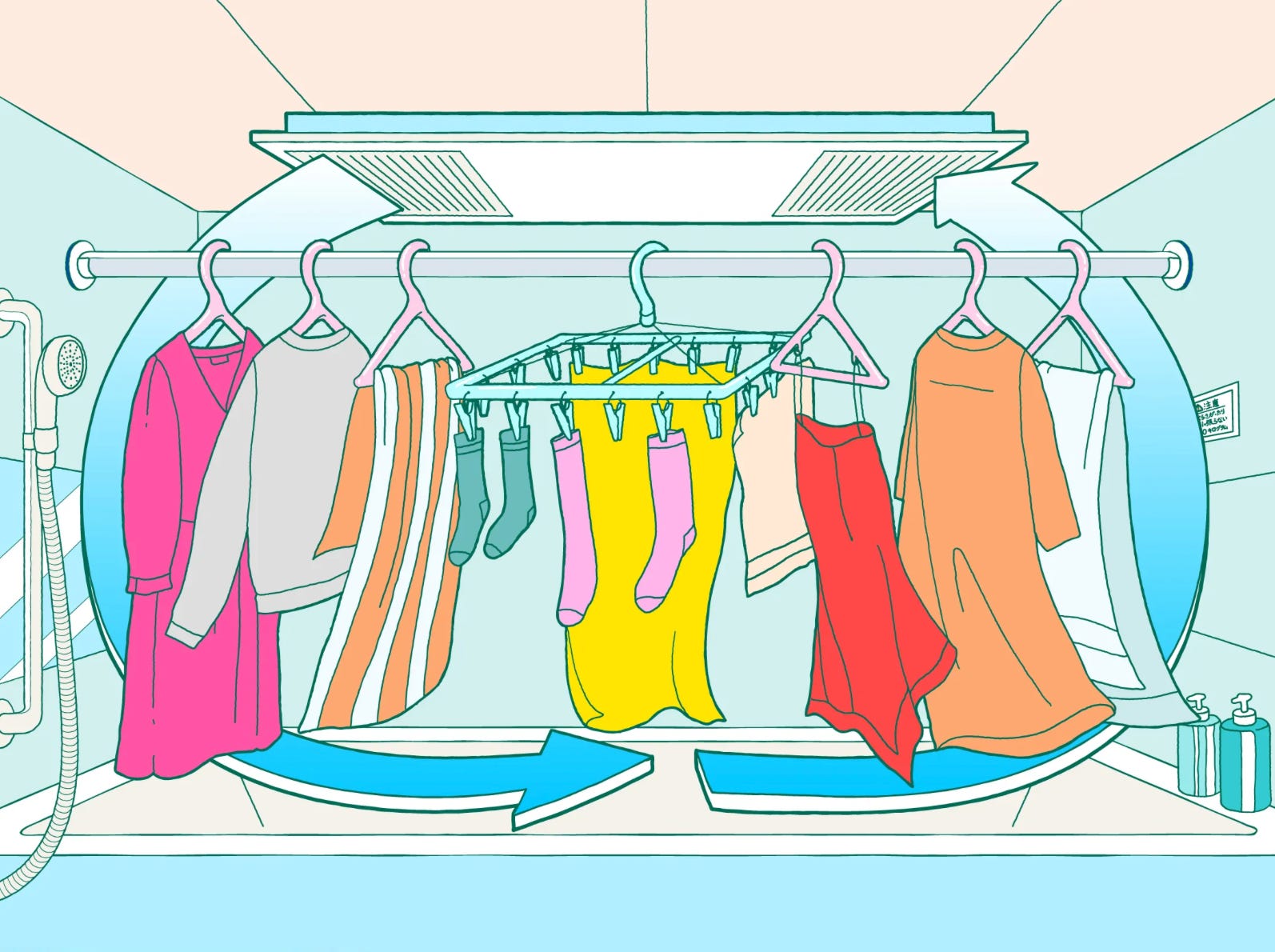
The lack of dryers led to a pretty clever innovation: bathroom drying systems.
These are called 浴室乾燥機 (yokushitsu kansōki) and they’re surprisingly common in modern homes. As most of you readers know, Japanese bathroom’s are designed as a sealed waterproof room, so you can hang clothes from a bar inside the shower area, press a button, and the ceiling unit will circulate warm air to dry and deodorize the laundry.
Many systems can also heat the bathroom in winter, ventilate humidity, or cool the space in summer.
So instead of a big standalone dryer, the bathroom itself becomes the drying machine.
It’s a small design choice, but it says a lot about how homes in Japan are built. Rather than adding more appliances, the architecture adapts to solve the problem.
And that raises an interesting question.
If Europe avoids dryers because of old buildings, and Japan avoids them because of cultural habits and home design…
Why are dryers so common in the United States?
The answer mostly comes down to post-war suburban life.
After World War II, American suburbs exploded in size. Houses were larger, land was cheaper, and new homes were being built with dedicated laundry rooms and basements. At the same time, the appliance industry aggressively marketed the idea of a “modern home” filled with labor-saving machines.
Electricity was also extremely cheap in the United States compared with most of the world.
So dryers became standard.
By the 1980s, over 70–80% of American homes already had clothes dryers, and today that number is well over 85%. In many American homes, a dryer isn’t even considered an appliance, it’s just assumed to be part of the house.
In Japan and much of Europe, laundry stayed a daily routine tied to the architecture of the home.
In the United States, it became another machine in the laundry room.
Two very different ways of solving the same problem.
Browse opportunities yourself: Check out current listings at Nipponhomes.com
Book Consultation | Subscribe to our newsletter
We’ve been building out a solid list of travel + ski partnerships lately.
If you’re gearing up for a trip and need things like luggage, Goggles, insurance and much much more there are some really good deals below.
We’re always looking to partner with great travel + ski brands.
If you’d like to be featured on our perks page or partner with us, reach out here:
This content is for informational and educational purposes only and reflects my personal opinions and experience. I am not a licensed financial advisor, tax advisor, or attorney. Readers should conduct their own due diligence and consult qualified professionals before making any investment decisions.
Subscribe